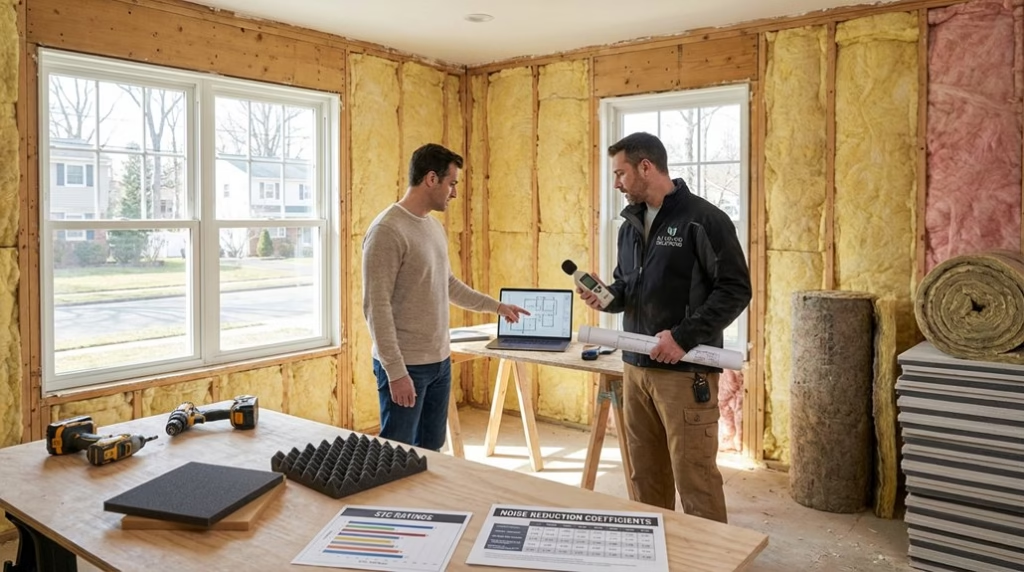
Hiring a professional to soundproof your home office means investing in a complete noise-control strategy, not a few isolated fixes that leave weak points behind. At Total Home Interiors, that process starts with identifying flanking paths and evaluating how sound moves through the walls, ceiling, floor, doors, windows, HVAC, and every penetration around the room. A qualified specialist should deliver written specifications, assembly details, and construction-ready plans for the full acoustic shell so your contractor has a clear roadmap to follow. That level of planning is what separates professional soundproofing from trial-and-error upgrades. Keep reading to learn exactly what to ask for when comparing soundproofing experts in West Orange, Hoboken, Jersey City, and the greater NYC area.
Key Takeaways
- Hire a soundproofing specialist who plans your home office as one complete acoustic shell, not a series of disconnected wall, door, and window fixes.
- Expect construction-ready soundproofing plans that spell out wall, ceiling, floor, perimeter, and junction details so contractors can build it correctly the first time.
- Make sure the design addresses flanking noise at ceilings, floors, HVAC paths, doors, windows, and structural connections where sound can slip past standard upgrades.
- Require detailed treatment of HVAC, electrical, and other penetrations, including proper sealing, gasketing, and vibration isolation to prevent hidden sound leaks.
- Vet the professional by asking for written specifications, coordination responsibility, and examples of past office soundproofing projects with a documented noise-control strategy.
What Should a Soundproofing Expert Deliver?
When you hire a soundproofing expert, you shouldn’t get a piecemeal fix for a wall, door, or window—you should get a complete sound isolation plan that shows how your home office will perform as a system. At Total Home Interiors, that means clear detailing for every wall assembly, plus flanking-path control at the floor, ceiling, and adjoining junctions so noise doesn’t bypass the main construction.
A qualified expert should also provide penetration detailing for HVAC, electrical, doors, and windows, identifying where sound can leak and how each opening will be sealed, isolated, or decoupled. They should also specify acoustic sealant at gaps, seams, and penetrations to maintain an airtight barrier and prevent small openings from compromising overall isolation.
You should receive written plans, material specifications, and coordination details that reduce guesswork for your contractor and keep all trades aligned with the acoustic intent.
That level of documentation helps prevent costly mistakes, protects performance, and delivers the quiet, privacy, and focus homeowners across West Orange, NJ, and the Tri-State area expect from a professionally designed soundproofing solution.
Why Must Soundproofing Be Planned as One System?
Soundproofing has to be planned as one complete system because noise never travels through just one surface. In homes and commercial spaces across West Orange, Jersey City, Hoboken, and NYC, sound often bypasses a single upgraded wall through the ceiling, floor, doors, windows, ductwork, and structural connections.
Effective soundproofing works as a complete system, since noise often bypasses one upgraded surface through surrounding assemblies and structural pathways.
That flanking noise is one of the main reasons DIY soundproofing efforts fall short, even when expensive materials are used.
At Total Home Interiors, we approach soundproofing as a coordinated construction strategy, not a patchwork of isolated fixes. Effective results depend on how wall, ceiling, and floor assemblies work together, with careful detailing at every joint, penetration, and transition.
A well-designed system also uses decoupling methods and sound-absorbing materials together to control both structure-borne vibration and airborne noise.
Without that level of planning, contractors may unintentionally create weak points during installation that undermine the entire system.
HVAC is especially important, since ducts, vents, and mechanical pathways can carry noise directly into a space if they aren’t addressed correctly. The same is true for windows, doors, and perimeter conditions.
When soundproofing is designed, documented, and integrated as one system from the start, you get predictable performance, better privacy, and a quieter space that actually meets expectations.
What Drawings Should a Soundproofing Expert Provide?
At a minimum, a soundproofing expert should provide a complete, project-ready drawing set for your entire home office soundproofing system—not just a few marked-up walls.
After the site survey, you should expect a clearly defined drawing package with assembly details for every wall, floor, ceiling, and critical transition point.
In a proper soundproofing project, performance depends on how every surface and junction works together, so your contractor should never have to guess in the field.
Look for:
- Plans showing how the sound-isolated layers fully surround the office like a continuous acoustic shell.
- Sections illustrating clips, channels, drywall layers, insulation, seams, and perimeter conditions in cross-section.
- Penetration details for outlets, switches, recessed elements, doors, windows, HVAC, and any other weak points where sound can leak.
The drawing set should also include coordination notes that explain how each detail connects into one complete noise-control system. This kind of complete documentation matters even more if the office will be used with whole home audio video systems that distribute media throughout the house.
Without that level of documentation, builders may unintentionally compromise the assembly during construction—and that can undermine the results you’re paying for.
How Should a Soundproofing Expert Handle HVAC?
A soundproofing expert should address HVAC from the very beginning of the project, not treat it as a separate mechanical item later. At Total Home Interiors, we plan HVAC as part of the overall soundproofing strategy so ducts, penetrations, plenums, and equipment housings don’t become hidden flanking paths that undermine walls, ceilings, and floors.
HVAC must be integrated into soundproofing from the start, or hidden flanking paths can compromise the entire isolation system.
A proper soundproofing plan should include clear documentation for duct sealing, acoustic barrier layout, and register detailing. That means specifying airtight, fire-rated transitions, appropriate backer materials, and gasketing so every opening supports the isolation system instead of weakening it. Effective HVAC sound control also depends on maintaining airtight seals around penetrations, since even small gaps can allow airborne noise to bypass otherwise well-built assemblies.
Your expert should also coordinate mechanical isolation measures such as vibration hangers, sleeves, flexible duct connectors, and dampers to reduce structure-borne noise. Just as important, supply air, return air, fresh air, and make-up air all need to be integrated into the acoustic plan.
When every intake and exhaust penetration is documented in advance, contractors can install the system correctly and avoid costly jobsite conflicts.
For homeowners and commercial clients in West Orange, NJ, and across the Tri-State area, this level of planning is what separates professional soundproofing from partial fixes that fail to deliver real quiet.
How Can You Vet a Soundproofing Expert Before Hiring?
Once you understand how HVAC can make or break a quiet room, the next step is vetting whether a soundproofing expert can document the entire assembly before construction begins.
During a site inspection, ask for:
- A complete soundproofing plan showing each wall, ceiling, and floor assembly, including isolation methods and a clearly defined scope of work.
- Written HVAC coordination explaining how ducts, vents, penetrations, and openings will be handled so noise leakage doesn’t undermine the system.
- Construction-ready drawings identifying doors, windows, electrical boxes, and plumbing details, rather than leaving critical isolation decisions unresolved.
You should also confirm they approach soundproofing as a fully integrated system—not a collection of separate fixes. That means coordinating structure, HVAC, and the building envelope together, while accounting for flanking paths that can carry sound around the main assemblies.
Ask who’s responsible for that coordination, and request examples of past projects that show a documented, professional isolation strategy. A qualified expert should also be able to explain how materials such as mass-loaded vinyl or mineral wool fit into the overall assembly to control airborne noise effectively.
For homeowners and commercial clients in West Orange, Hoboken, Jersey City, and the greater NYC area, this level of planning is what separates a true soundproofing specialist from a contractor offering guesswork.
Frequently Asked Questions
How Much Does It Cost to Soundproof a Home Office?
You can expect to invest roughly $1,000–$10,000 for limited home office soundproofing improvements, while a true construction-based isolation package often ranges from $10,000 to $50,000+ depending on the scope.
Final pricing is shaped by wall and ceiling area, door and window upgrades, HVAC noise control, electrical adjustments, and the level of sound isolation required.
While DIY methods may appear less expensive upfront, professionally designed and installed systems typically deliver far better performance, fewer mistakes, and more reliable long-term results.
At Total Home Interiors, we help homeowners in West Orange, NJ and across the Tri-State area create quieter, more private workspaces with premium soundproofing solutions tailored to the room, the noise source, and the expectations for everyday comfort.
How Do I Soundproof My Home Office?
Soundproofing a home office works best when the entire room is treated as one sealed system. Weak points in the walls, ceiling, floor, doors, windows, or HVAC paths can all allow sound to transfer, which is why professional soundproofing requires more than surface-level fixes.
At Total Home Interiors, we design custom noise-control solutions using proven construction methods such as decoupled walls, acoustic drywall, mass-loaded vinyl, and properly specified acoustic doors and windows.
For homeowners in West Orange, Hoboken, Jersey City, and throughout the Tri-State area, this creates a quieter, more private workspace that supports focus, video calls, and daily comfort.
While rugs and weatherstripping may help reduce minor distractions, lasting results come from a professionally planned enclosure designed to control noise at every entry point.
Conclusion
Hiring a soundproofing professional for your home office is about far more than stuffing insulation into the walls. It takes a true acoustic strategy to reduce noise transfer, improve privacy, and create a workspace that supports concentration and clear communication. At Total Home Interiors, we approach every office as a complete system—evaluating walls, ceilings, floors, windows, and even HVAC pathways that can carry unwanted sound.
The right expert should provide clear recommendations, detailed drawings, and proven solutions such as mass-loaded vinyl, decoupled wall assemblies, and acoustic drywall where appropriate. Just as important, they should understand how to balance soundproofing with acoustics, so your office feels quiet, controlled, and comfortable for everyday work.
For homeowners in West Orange, NJ, Jersey City, Hoboken, and across the Tri-State area, professional soundproofing offers a lasting alternative to DIY guesswork. When designed and installed correctly, your home office becomes a private, high-performance environment—calm, focused, and built for the way you live and work.