
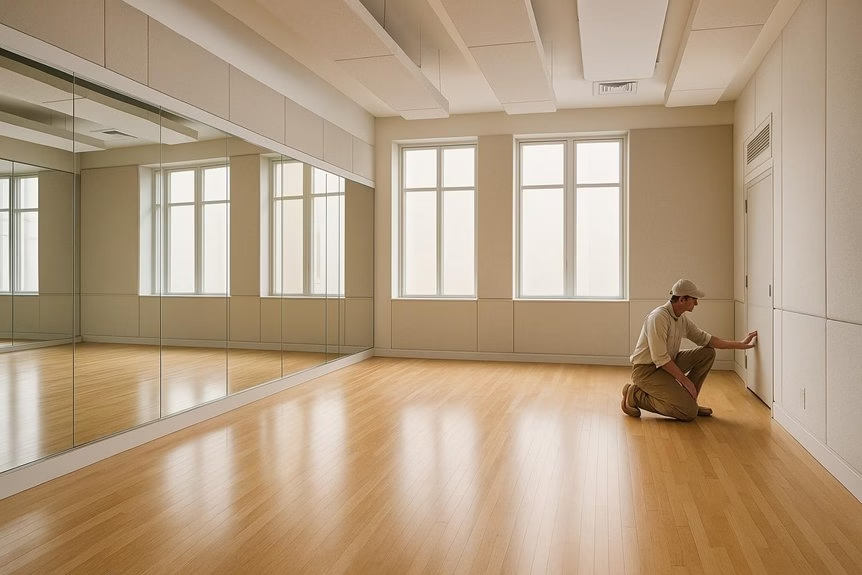
Choose an acoustic contractor who begins with a detailed site survey, baseline sound measurements, and a clear assessment of airborne, impact, and flanking noise paths. For Pilates and dance studios, that means recommending studio-specific soundproofing and acoustic solutions—not generic products. Look for expertise in decoupled wall and ceiling assemblies, truly isolated or floating floors, sealed doors and windows, and HVAC vibration control that protects both comfort and sound performance.
A qualified contractor should specify complete systems, not just individual materials, and explain how each element works together to reduce noise transfer and improve sound quality inside the space. The best firms also provide before-and-after testing, a transparent line-item budget, and a realistic installation timeline. In the Tri-State area, working with an experienced team like Total Home Interiors helps ensure your studio is designed for lasting performance, privacy, and a better client experience—not guesswork.
Key Takeaways
- Choose an acoustic contractor who clearly distinguishes airborne noise from impact noise, evaluating both music leakage and structure-borne footfall or jumping vibration to create the right soundproofing strategy for a Pilates or dance studio.
- Look for a specialist who performs a detailed site survey, room walkthrough, and baseline sound measurements before making recommendations, ensuring the solution is based on real conditions rather than guesswork.
- Prioritize contractors who inspect common leakage points such as doors, windows, ceilings, outlets, penetrations, and other flanking paths that allow noise to travel between spaces.
- Select experts who design complete wall, ceiling, and floating floor assemblies using proven soundproofing methods like decoupling, added mass, insulation, and airtight sealing for lasting performance.
- Expect a thorough review of HVAC and equipment noise, along with before-and-after testing to verify measurable acoustic improvements by room and frequency range.
How Will the Acoustic Contractor Assess the Studio?
When a Total Home Interiors acoustic specialist assesses your Pilates or dance studio, the process starts by separating the problem into two categories: airborne noise and impact noise.
Airborne noise includes music, voices, and sound escaping through walls, doors, windows, and ceilings.
Impact noise comes from footfalls, jumps, and vibrations transferring through the floor structure and joists.
Next, we perform a detailed site survey and room walkthrough to identify the most likely leakage paths and structural weak points.
That includes checking door bottoms and seals, window performance, wall construction, ceiling conditions, and whether decoupled assemblies or upgraded soundproofing materials may be appropriate.
We also establish a measurement baseline so recommendations are based on the actual space, not guesswork.
From there, we evaluate the room’s acoustic behavior by mapping reflections, echo-prone surfaces, and uneven sound zones.
In movement studios, low-frequency buildup can also become a factor, especially with amplified music, so we assess whether standard shallow treatments will be enough or whether deeper broadband acoustic absorption is needed.
We also look for places where acoustic caulk may be needed to seal small gaps around fixtures, outlets, and other penetrations that can leak sound.
Finally, you’ll receive a clear summary of priorities, practical solutions, and measurable goals—so you understand what should be addressed first to improve both sound isolation and in-room acoustics.
How Will They Control Airborne and Impact Noise?
Controlling noise starts by separating the problem by sound type.
Airborne noise, like music, voices, and instructor cues, requires mass, airtight sealing, and carefully detailed construction.
Impact noise, such as footfalls, stomping, or dropped props, requires decoupling and vibration isolation.
At Total Home Interiors, we help homeowners and commercial clients across West Orange, NJ, Jersey City, Hoboken, and NYC understand this difference because effective soundproofing depends on treating the right source the right way.
At Total Home Interiors, we help clients across New Jersey and NYC match the right soundproofing strategy to the right noise source.
Ask your contractor exactly how they plan to reduce airborne sound transmission.
The right answer should include sealed penetrations, solid-core gasketed doors, acoustic glazing where needed, and wall or ceiling assemblies designed to block sound, not just absorb it.
Premium soundproofing solutions may also include decoupled wall systems, acoustic drywall, and other professionally specified materials that address real-world leakage paths.
For impact noise, expect more than basic insulation.
A proper solution may involve a floating or decoupled floor, resilient underlayment, isolation pads, or spring-mounted assemblies that reduce vibration before it travels into adjacent spaces.
Request assembly details showing which components are intended to control airborne noise and which are there to isolate impact vibration.
It’s also critical to address flanking paths, the overlooked routes sound uses to bypass otherwise strong assemblies.
Cracks, doors, windows, and penetrations can leak noise directly, while joists, ceilings, walls, and floor edges can carry structure-borne vibration throughout the building.
Be cautious of insulation-only proposals.
Insulation can help within a complete system, but by itself it won’t stop sound leakage or structural vibration.
For better airborne sound isolation, contractors may specify multiple layers of drywall with Green Glue to add mass and damping between rooms.
Ventilation noise and echo control matter as well, especially in multi-use residential and commercial environments, but the first priority should be transmission control.
Once noise transfer is properly addressed, acoustic treatments can then improve comfort, clarity, and privacy within the space.
Can They Reduce HVAC and Equipment Noise?
Because HVAC and equipment noise usually travels through ductwork, wall penetrations, and vibrating mechanical systems—not just directly through a wall—you should ask whether the contractor performs a complete noise-path assessment and treats both airborne sound and structure-borne vibration.
During the site assessment, ask how they identify noise moving through supply and return ducts, diffusers, sleeves, soffits, wall penetrations, and fan assemblies.
A qualified soundproofing specialist should recommend proper equipment isolation, including vibration mounts for rooftop units, condensers, air handlers, and mini-splits, along with vibration pads and resilient supports for AV racks, speakers, subwoofers, and other equipment that can transfer noise into the structure.
You should also ask whether they specify acoustically lined duct sections—not just standard thermal insulation—and whether duct decoupling or other sound-control measures are included where needed.
Confirm that penetrations, sleeves, and curb mounts are sealed with appropriate firestopping and acoustical sealants to limit flanking noise paths.
In more complex build-outs, they may also recommend resilient channels or other decoupling methods where mechanical noise is transferring through adjacent walls or ceilings.
Strong contractors will also provide realistic sound reduction expectations, often by frequency range or octave band, and verify performance with before-and-after sound level testing.
For homeowners and businesses in West Orange, Hoboken, Jersey City, and the greater NYC area, this level of detail separates true acoustic professionals from general contractors offering surface-level fixes.
Which Wall Treatments Improve Dance Studio Isolation?
Wall treatments can absolutely improve dance studio isolation, but the best results come from a professionally designed soundproofing system, not a single product. For studios in homes or commercial buildings, Total Home Interiors recommends dense, multi-layer wall assemblies such as acoustic drywall and mass-loaded vinyl to reduce airborne noise from music, voices, and instruction.
Equally important, every seam, outlet, perimeter edge, and wall penetration must be sealed with acoustical sealant. Even small gaps can compromise the performance of an otherwise well-built wall. To further limit sound transfer, decoupling methods like resilient channels, isolation clips, or separated stud walls are often essential, especially in studios where vibration is a concern.
Insulation alone isn’t enough. It can help absorb sound within the wall cavity, but it doesn’t provide the level of isolation needed for serious dance or music use. A proper wall build-out should be specified with clear performance goals, such as STC targets, along with material layers, cavity insulation, decoupling method, and overall wall thickness. Adding Green Glue between drywall layers can further improve damping and help raise overall sound isolation performance.
For many dance studios, footfall and impact noise may also require coordinated floor soundproofing. That’s why expert planning matters. Total Home Interiors designs complete acoustic and soundproofing solutions for clients across West Orange, NJ and the Tri-State area, helping create quieter, more functional spaces without relying on guesswork or DIY shortcuts.
Which Ceiling Treatments Improve Echo and Isolation?
How do you improve echo and isolation at the ceiling in a Pilates or dance studio? The most effective approach starts with a professionally designed decoupled ceiling assembly, such as isolation clips and hat channel or resilient channel. This separation helps reduce structure-borne vibration and limits noise transfer into the joists above, which is especially important in commercial studios where impact, music, and voice noise can travel into adjacent spaces.
If the space uses a suspended ceiling, better results usually come from combining several elements: added mass above the ceiling plane, insulation in the plenum, and sound-absorbing finishes below. A qualified acoustic contractor may recommend an additional drywall layer or specialty sound barrier above the tiles, along with mineral wool or fiberglass insulation, to improve isolation while also supporting better overall acoustic performance. Insulation alone isn’t a true soundproofing solution, so it should be part of a larger ceiling system rather than the only treatment. Sealing around penetrations and perimeter joints with acoustic sealant also helps maintain an airtight ceiling barrier and prevent sound leaks that can weaken isolation.
For suspended ceilings, the best results come from combining mass, insulation, and sound-absorbing finishes into one coordinated system.
For studios with high ceilings or open layouts, acoustic clouds or baffles can significantly reduce harsh overhead reflections and shorten reverb time without taking up valuable floor area. These treatments are often ideal for dance, fitness, and movement spaces where clear music, instructor speech intelligibility, and a more comfortable sound environment matter.
Because ceiling soundproofing often involves structural load considerations, plenum coordination, and post-installation testing, this isn’t an area for guesswork. At Total Home Interiors, we design and install custom acoustic ceiling solutions for studios, commercial spaces, and luxury residences throughout West Orange, NJ and the Tri-State area, helping clients achieve both stronger isolation and better sound quality with a professional, integrated approach.
Which Floor System Best Reduces Impact Noise?
Impact noise is best controlled with a professionally designed floating floor system that stops vibration before it transfers into the structure. For Pilates, dance, fitness, and other high-footfall spaces, decoupling the finished floor from the slab or joists delivers the strongest structure-borne noise reduction. Proper gap sealing around doors and wall penetrations can further improve overall isolation by limiting sound leakage from adjacent spaces.
- Spring mounts are often the best choice when jumping, stomping, and repetitive impact are the main concerns. These systems typically require 3–4 inches of build height and provide excellent isolation in demanding studio environments.
- Floor pucks offer a lower-profile floating subfloor option, usually needing 2–3 inches while still delivering very good impact-noise control.
- Where floor height is limited, rubber pads or acoustic underlayment can help, typically ranging from ¼–½ inch up to 1–2 inches depending on the assembly. These solutions can improve performance, but they generally don’t isolate impact as effectively as a true floating floor.
- If the finish surface is Marley or vinyl, it should be installed over a proper isolation layer, since the dance surface itself provides only modest impact-noise reduction.
For homeowners, studios, and commercial spaces in West Orange, NJ and the Tri-State area, selecting the right floor assembly depends on ceiling height, structural conditions, and the level of noise control required. Total Home Interiors designs custom soundproofing solutions that prioritize real-world performance, not one-size-fits-all products.
How Will They Soundproof Doors, Windows, and Gaps?
Even with a well-built studio shell, doors, windows, and perimeter gaps are often the weakest points for noise transfer.
A qualified acoustic contractor should treat these openings as critical leak paths, using airtight acoustical caulking, frame gaskets, and professional perimeter sealing to close every small gap around the assembly.
A skilled acoustic contractor seals openings as critical leak paths with acoustical caulking, frame gaskets, and airtight perimeter sealing.
For doors, ask whether they specify solid-core acoustic door assemblies—not standard hollow-core doors—along with hardware designed for compression sealing.
Effective soundproofing typically includes acoustic seal kits, tight door sweeps, and threshold seals to reduce sound leakage at the bottom of the door.
For windows, ask whether upgraded double- or triple-pane glazing, laminated glass, or interior window inserts will create the airspace and mass needed to reduce outside noise more effectively than single-pane glass.
In many cases, laminated glass paired with interior acoustic inserts can deliver a more substantial reduction in outside traffic noise.
If acoustic curtains are mentioned, they should be presented only as a minor enhancement—not a true soundproofing solution.
At Total Home Interiors, we evaluate these details as part of a complete soundproofing strategy for homes and commercial spaces across West Orange, NJ, Jersey City, Hoboken, NYC, and the surrounding Tri-State area.
What Results, Budget, and Timeline Should They Provide?
Before you hire an acoustic contractor, ask for clear, measurable results, a detailed budget, and a realistic installation timeline. At Total Home Interiors, we believe every acoustic treatment project in West Orange, NJ and the Tri-State area should begin with defined expectations—not vague promises.
- Set performance targets with measurable outcomes. Ask for goals such as improved speech intelligibility, reduced echo, shorter RT60 reverberation times, and better bass control based on treatment depth and room use.
- Request clearly defined deliverables. Your proposal should distinguish acoustic treatment from soundproofing, so you know whether the project is improving sound quality inside the room, reducing noise transfer, or both.
- Review a line-item budget. Costs should be broken down for acoustic wall panels, ceiling clouds, baffles, fabric wall systems, and corner bass traps, with options for different panel depths, finishes, and coverage levels. Ask whether specified products meet strong NRC ratings so you can compare sound absorption performance across materials and panel types.
- Confirm the project schedule and installation sequence. A professional contractor should outline on-site evaluation, product specification, material lead times, installation order, and post-installation verification to confirm results.
You should also receive a placement plan showing the exact locations for panels, ceiling treatments, or mobile acoustic solutions, so there’s no guesswork during installation.
Frequently Asked Questions
Do They Have Experience With Pilates and Dance Studios Specifically?
Yes, you should confirm they’ve direct experience with Pilates and dance studios specifically. These spaces present unique acoustic challenges, and you need a professional who understands how mirrored walls, sprung floors, open ceilings, and amplified music affect both sound quality and noise transfer.
It’s also important to ask about barre and movement-based classes, since rhythmic activity creates different demands than a typical fitness space.
A qualified acoustic specialist should be able to show relevant studio projects, explain the soundproofing and acoustic treatments they recommended, and demonstrate how they solved real-world noise and echo issues.
Can They Balance Sound Control With the Studio’s Aesthetic Design?
Yes—you can have refined design and effective acoustic control in the same studio. At Total Home Interiors, we integrate acoustic treatments into the overall aesthetic so the space looks intentional, not overbuilt. That can include custom fabric-wrapped panels, ceiling treatments, and discreet wall solutions matched to your materials, colors, and architectural lines.
The result is clearer sound and reduced echo without compromising the studio’s visual identity. If a contractor can’t show past projects that combine strong acoustics with polished design, it’s worth questioning their experience.
Will Acoustic Treatments Affect Mirror Placement or Natural Lighting?
Yes—acoustic treatments can influence mirror placement and natural lighting, especially in studios where wall space, reflections, and brightness all matter.
At Total Home Interiors, we plan acoustic panels, ceiling treatments, and soft materials in a way that improves sound quality without making the room feel closed in or visually heavy.
With the right layout, treatments can be positioned to preserve key mirror locations and maintain as much natural light as possible.
Early coordination is the best approach, allowing our team to balance acoustics, aesthetics, and functionality for a studio that feels bright, open, and professionally designed.
Do They Offer Post-Installation Testing and Tuning Services?
Yes—and they should.
At Total Home Interiors, we believe post-installation testing and tuning are essential to any professional acoustic solution.
It’s how you confirm the space performs as intended, whether that means reducing outside noise, improving speech clarity, or balancing sound within the room.
A qualified contractor should verify results after installation and make adjustments to acoustic panels, sound masking systems, or related components as needed.
Without that step, you’re relying on assumptions instead of measured performance.
Always ask for clear benchmarks, documented results, and follow-up support before moving forward.
Can They Work Around Class Schedules to Minimize Disruption?
Yes—an experienced contractor should absolutely work around your class schedule to minimize disruption. For yoga studios, fitness spaces, and other active commercial environments, the right partner will create a phased installation plan, schedule louder work during off-hours, and coordinate crew access carefully so your sessions can continue with minimal interruption.
At Total Home Interiors, we understand that protecting your clients’ experience is just as important as improving the space itself. Ask how they manage low-noise work periods, daily cleanup, communication with staff, and timeline adjustments if your schedule changes.
A professional team should keep the project efficient, safe, and organized from start to finish while delivering acoustic improvements that support a calmer, more functional environment.
Conclusion
When choosing an acoustic contractor for your Pilates or dance studio, look for a team with proven expertise in both soundproofing and acoustic treatment. At Total Home Interiors, we evaluate how noise travels through walls, ceilings, floors, doors, and other weak points before recommending solutions such as acoustic panels, ceiling treatments, decoupled assemblies, and premium sound-isolation materials. The right contractor should deliver a plan that improves focus, comfort, and speech clarity while respecting your budget and construction timeline. That matters in active studio environments, where excessive noise and echo can disrupt instruction, reduce concentration, and affect the overall client experience. With a professionally designed acoustic strategy, your studio can feel calmer, more polished, and better aligned with the high-quality experience your clients expect.
