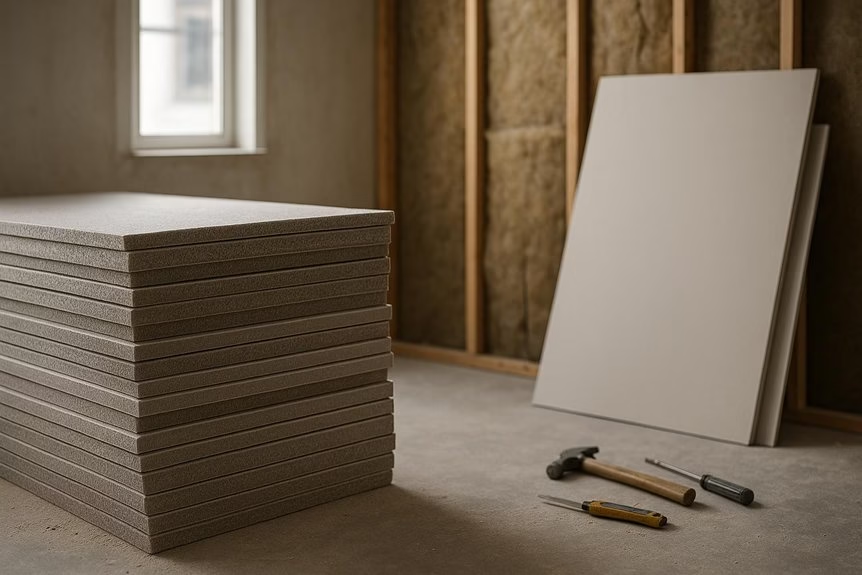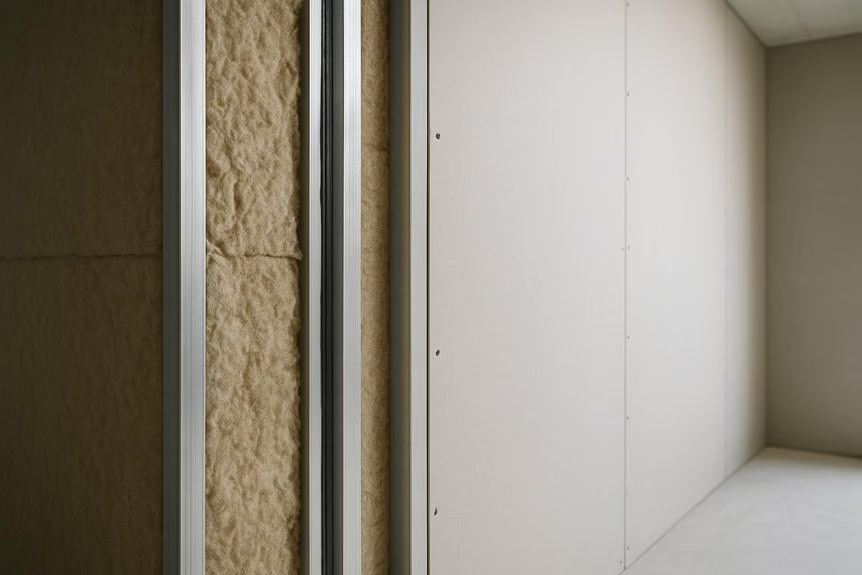
Sound insulation drywall can help reduce noise, but on its own, it usually delivers only a modest improvement over standard drywall. In real-world tested wall assemblies, 5/8-inch standard drywall with mineral wool insulation performed about as well as some specialty acoustic drywall options. The biggest reductions in noise transfer typically come from a complete soundproofing strategy: insulation, multiple drywall layers, damping compounds, and decoupled wall construction working together. For homeowners and businesses in West Orange, Hoboken, Jersey City, and NYC dealing with neighbor noise, street noise, or privacy concerns, the wall assembly matters far more than upgrading to one premium panel alone. At Total Home Interiors, we design professional soundproofing systems that address the full structure—not just the surface—for results that are worth the investment.
Key Takeaways
- Acoustic drywall can be a worthwhile upgrade for modest sound reduction, but by itself it is rarely the most effective solution for stopping noise transfer.
- In one tested wall assembly, standard 5/8-inch drywall with rockwool performed at about 72 dB, while 1/2-inch QuietRock reached about 71 dB—showing that specialty drywall alone may not justify the added cost.
- The most meaningful soundproofing gains came from complete wall systems that combine insulation, added mass, damping, and professional construction methods.
- A double-drywall assembly with rockwool and damping reduced sound to about 64 dB, significantly outperforming single-layer drywall upgrades.
- For homeowners and commercial spaces dealing with neighbor noise, street noise, or privacy concerns, it often makes more sense to prioritize rockwool, double drywall, Green Glue, and decoupling before investing in acoustic drywall alone.
- At Total Home Interiors, we help clients across West Orange, NJ and the Tri-State area choose the right soundproofing strategy for their space, budget, and noise issues—because better results come from a properly engineered assembly, not just a premium product.
Is Sound Insulation Drywall Worth It?
Is sound insulation drywall worth it? Sometimes, but usually not as the first upgrade.
Sound insulation drywall can help, but it rarely delivers the biggest noise reduction on its own.
In most walls, the biggest gains come from addressing the full assembly: insulation, added mass, damping, and construction methods that reduce sound transfer.
Testing shows standard 5/8-inch drywall over a hollow cavity measured about 78 dB.
Adding rockwool behind standard drywall reduced that to roughly 72 dB, while switching to acoustic drywall with rockwool reached about 71 dB.
That means specialty drywall alone often delivers only a modest improvement.
For homeowners dealing with neighbor noise, street noise, or work-from-home distractions, better performance typically comes from a more complete soundproofing strategy.
Assemblies using insulation, damping sealant, and multiple drywall layers performed best, reducing noise to about 64 dB.
In many cases, professionally designed solutions such as decoupled walls, mass-loaded vinyl, acoustic drywall, and proper perimeter sealing will outperform a simple material swap.
As with acoustic panel planning, identifying primary reflection points and other sound paths helps ensure upgrades address the full room system rather than just one material.
At Total Home Interiors, we help clients in West Orange, Hoboken, Jersey City, and across the NYC area choose the right soundproofing approach for their space, budget, and privacy goals.
If you’re considering acoustic drywall, it should be evaluated as part of a broader wall system, especially in spaces where moisture control, wall thickness, and installation complexity matter.
QuietRock vs Standard Drywall at a Glance
QuietRock isn’t a cure-all, but it can provide a measurable soundproofing advantage over standard drywall in the right wall assembly. For homeowners and property managers dealing with neighbor noise, street noise, or limited privacy, that small performance gain can matter—especially when every layer of protection counts.
- In this comparison with rockwool insulation, 1/2-inch QuietRock measured about 71 dB, while 5/8-inch standard drywall came in around 72 dB.
- That result shows the thinner engineered panel performed slightly better than thicker conventional drywall in this setup.
- When silicone damping was added, QuietRock still maintained a modest lead at roughly 70 dB versus 72 dB.
- The difference appears to come from QuietRock’s mass-and-damping construction, not thickness alone.
Pairing sound-insulating drywall with Green Glue between layers can further reduce noise transmission by adding damping to the wall assembly.
For Tri-State homeowners looking to reduce sound transfer without significantly increasing wall depth, products like acoustic drywall can play an important role—but results depend on the full system, not just one material.
At Total Home Interiors, we design complete soundproofing solutions for walls, ceilings, and shared boundaries to deliver more reliable noise control than a simple DIY material swap.
How Much Sound Can Drywall Block?
A more useful question is how much sound drywall can reduce in a real wall assembly, not just on its own. In these test results, a hollow wall measured about 78 dB.
After adding rockwool insulation and a single layer of 5/8-inch drywall**, the reading dropped to around 72 dB—about a 6 dB improvement** from combining insulation with standard wall mass.
Using 1/2-inch QuietRock with rockwool brought the level to about 71 dB, showing a modest improvement, but not a dramatic one when the drywall layer is thinner.
The more meaningful gains came from combining mass, damping, and better wall construction techniques. A double-layer assembly with rockwool and silicone damping** measured roughly 64 dB, which is about 14 dB lower than the hollow wall and 7 to 8 dB better than the insulated single-drywall setup**.
In many cases, adding resilient channels can further improve performance by helping decouple the drywall from the framing and reduce vibration transfer.
The takeaway is that drywall helps, but true soundproofing performance depends on the full system—including insulation, damping, layering, and installation quality.
For homeowners in West Orange, Hoboken, Jersey City, and NYC dealing with neighbor noise, street noise, or poor privacy, professionally designed wall assemblies typically deliver far better results than simple DIY upgrades.
Because field conditions vary, these numbers should be treated as practical ranges rather than exact guarantees.
Why Rockwool Beats a Hollow Wall
A hollow stud cavity does very little to stop noise. Without insulation, sound waves bounce inside the wall cavity and create resonance, which is why your baseline test averaged about 78 dB.
- Add rockwool insulation with 5/8-inch drywall, and the reading drops to about 72 dB.
- That roughly 6 dB improvement comes from the dense, porous fibers absorbing sound energy and reducing vibration inside the wall.
- Upgrade the face layer to 1/2-inch QuietRock, and rockwool still delivers about 71 dB, showing how effective it’s at controlling cavity resonance.
- Combine rockwool with acoustic sealant and double drywall, and performance improves further to about 64 dB.
This added performance becomes even stronger when paired with Green Glue damping between drywall layers to help convert sound energy into heat.
For homeowners in West Orange, Hoboken, Jersey City, and across the Tri-State area dealing with neighbor noise, street noise, or limited privacy, this is a clear example of why professional soundproofing design matters.
At Total Home Interiors, we use proven wall assemblies and premium acoustic materials to create quieter, more comfortable spaces than basic hollow-wall construction ever can.
Is QuietRock Better Than Extra Drywall?
Rockwool can do much of the work inside a wall cavity, but many homeowners still ask whether QuietRock outperforms simply adding another layer of drywall. In this comparison, the difference was small.
With Rockwool in the wall, standard 5/8-inch drywall measured about 72 dB, while 1/2-inch QuietRock came in around 71 dB.
A similar pattern showed up when air sealing was added. Rockwool plus silicone sealing plus standard drywall reached about 72 dB, while the QuietRock version landed around 70 dB.
That means acoustic drywall can help, but in this assembly, the improvement was modest.
In many cases, bigger gains come from improving the overall wall assembly and raising the STC rating through decoupling, insulation, and airtight sealing.
For many homes in West Orange, Hoboken, Jersey City, and NYC, performance often depends more on the full wall system than on one premium material alone. Factors like airtight sealing, proper decoupling, and resilient channel frequently have a greater impact on reducing neighbor noise and street noise than swapping in acoustic drywall by itself.
That’s why Total Home Interiors focuses on complete soundproofing solutions designed around the structure, not just a single product upgrade.
Why Double Drywall Works Better
Adding a second layer of 5/8-inch drywall increases wall mass, which is one of the most effective ways to reduce sound transfer.
In real-world soundproofing applications, that extra density consistently performs better than relying on a single upgraded sheet alone.
Using Green Glue between drywall layers can further absorb vibration and improve overall sound isolation.
Your test results make that clear:
- One layer helps, but has limits: rockwool with one 5/8-inch drywall layer measured about 72 dB.
- A single specialty panel offered only a modest change: one QuietRock layer came in around 71 dB, showing that one sheet alone won’t usually deliver a dramatic improvement.
- Two layers with damping performed far better: combining rockwool, damping compound, and double 5/8-inch drywall reduced noise to about 64 dB.
- Assembly details matter: Green Glue placement and air-gap decoupling also influenced results, with between-layer damping performing slightly better or similarly at roughly 63–64 dB.
Overall, that’s roughly a 10–14 dB improvement compared to a hollow wall measuring about 78 dB.
For homeowners in West Orange, Hoboken, Jersey City, and NYC dealing with neighbor noise, street sound, or poor privacy, this is why professionally designed double-drywall assemblies often outperform “upgrade one material” approaches.
True soundproofing comes from the full system—mass, damping, insulation, and proper construction—not just one premium panel.
Does Silicone Damping Help Enough?
Silicone damping can help, but in this test it delivered only a modest improvement on its own. With rockwool and standard 5/8-inch drywall, the result stayed near 72 dB with or without silicone.
With rockwool and 1/2-inch QuietRock, silicone brought the rounded result from about 71 dB to about 70 dB.
The more meaningful gains came from true soundproofing strategies, not caulk alone. In this case, adding a second layer of drywall for greater mass dropped results to roughly 64 dB, showing that mass loading had a far stronger impact.
This aligns with the mass law, where increasing wall mass generally improves sound isolation more effectively than minor damping tweaks alone.
Silicone placement also produced only minor variation, with readings around 63 to 64 dB whether it was installed between drywall layers or elsewhere.
For homeowners and commercial clients dealing with neighbor noise, street noise, or privacy concerns, this is an important takeaway: small material tweaks rarely outperform a professionally designed wall assembly.
The best results typically come from combining the right mass, damping, and construction methods as part of a complete soundproofing plan.
Because a single-speaker wall test can introduce artifacts, small 1 to 2 dB differences should be interpreted cautiously.
Best Wall Assembly for the Money
If you want the best wall assembly for the money, prioritize the fundamentals first: a properly insulated cavity and added drywall mass typically deliver better value than jumping straight to a specialty panel.
For the best value, build the wall assembly right first: insulation and drywall mass usually outperform specialty panels alone.
For homeowners and businesses dealing with neighbor noise, street noise, or limited privacy, the most effective upgrade path is usually:
- Fill the wall cavity with mineral wool insulation to reduce sound transmission.
- Add mass with multiple layers of drywall to improve measurable isolation.
- Consider specialty acoustic drywall as a secondary enhancement, not the starting point.
- Refine the assembly with decoupling methods such as resilient channel, stud layout adjustments, and other professional soundproofing details.
In practical terms, the strongest performance usually comes from building a dense, well-designed wall system first, then layering in premium materials where they make the most impact. Using Green Glue between drywall layers can further improve damping by converting sound energy into heat.
That’s why professionally planned soundproofing often outperforms piecemeal DIY upgrades.
At Total Home Interiors, we design and install custom soundproofing solutions for homes, apartments, condos, offices, and specialty spaces across West Orange, NJ and the Tri-State area—including Hoboken, Jersey City, and NYC—helping clients achieve quieter, more private interiors with the right combination of insulation, mass, and decoupling.
When Sound Insulation Drywall Makes Sense
Although specialty acoustic panels aren’t usually the first upgrade we recommend for blocking noise transfer, sound insulation drywall can make sense in a few specific situations.
For homeowners in West Orange, Hoboken, Jersey City, and NYC dealing with street noise, neighbor noise, or thin shared walls, products like QuietRock can provide a modest but meaningful improvement when they’re part of a professionally designed soundproofing assembly.
If the stud cavity is already insulated with mineral wool and retrofit conditions prevent adding wall thickness, acoustic drywall may be a practical next step for improving airborne noise control without major structural changes.
The best results come from combining mass and damping rather than relying on specialty drywall alone.
In testing, double-layer assemblies with damping compound performed significantly better, reaching about 64 dB, while single-layer systems remained closer to 70 to 72 dB.
For the upgrade to deliver its full value, the surrounding details matter just as much as the drywall itself.
Air sealing, vibration control, and proper stud decoupling are all essential to reducing sound transfer.
Sealing seams and perimeter gaps with acoustic caulk can also help prevent sound leakage that would otherwise reduce the performance of the wall assembly.
That’s why effective soundproofing is rarely about a single product—it is about the complete wall system, designed and installed correctly.
Total Home Interiors helps clients across the Tri-State area choose the right combination of acoustic drywall, decoupling methods, and premium soundproofing materials to create quieter, more comfortable spaces.
How to Choose the Right Wall Build
When choosing the right wall build, focus on the entire soundproofing assembly—not just one “premium” board and hoping for a dramatic result. At Total Home Interiors, we design wall systems around how sound actually moves through a space, with an emphasis on construction methods that deliver measurable performance for homes and commercial environments across West Orange, Hoboken, Jersey City, NYC, and the Tri-State area.
Effective soundproofing comes from the full wall assembly, thoughtfully designed for real-world performance—not from a single premium product alone.
- Start with insulation and mass. Mineral wool insulation paired with 5/8-inch drywall can significantly reduce noise transfer compared to an empty wall cavity.
- Add dense materials as part of a complete system. Acoustic drywall can provide incremental improvement, but it performs best when integrated with insulation, proper layering, and professional installation.
- Use damping where it matters. Acoustic sealants and damping strategies help reduce vibration transfer, especially when combined with multiple wall layers and sound-absorbing insulation.
- Minimize rigid connections. Decoupling methods such as resilient channel or isolated framing help prevent sound from traveling directly through the structure.
In many cases, resilient channels and cavity insulation together deliver more meaningful isolation gains than drywall upgrades alone.
You’ll also get better results by sealing air gaps, avoiding compressed insulation, and prioritizing separation first—then mass and damping.
For clients dealing with neighbor noise, street noise, or privacy concerns, the most effective solution is rarely DIY. It’s a professionally designed wall assembly tailored to the specific construction, noise source, and performance goals of the space.
Frequently Asked Questions
Can Sound-Insulation Drywall Be Installed Over Existing Drywall?
Yes, sound-insulation drywall can be installed over existing drywall when the surface is flat, dry, and structurally sound. While this type of acoustic layering can help reduce noise transfer, performance depends heavily on proper installation.
Studs must be accurately located, longer fasteners used, seams sealed with acoustic caulk, and outlet, trim, and door clearances addressed to avoid weak points that let sound leak through.
That said, adding another layer of drywall is rarely the complete solution for serious street noise, neighbor noise, or privacy concerns.
At Total Home Interiors, we evaluate the full wall assembly and recommend professional soundproofing strategies—such as acoustic drywall, decoupling methods, and other high-performance materials—designed to deliver more meaningful results for homes and commercial spaces across West Orange, NJ, Hoboken, Jersey City, and the greater NYC area.
If the existing wall has moisture damage, cracks, or unevenness, those issues should be corrected before any soundproofing work begins.
Does Sound-Insulation Drywall Require Special Screws or Fasteners?
Not always—many acoustic drywall products can be installed with standard drywall screws, but the correct fastener length, spacing, and installation method depend on the specific panel and wall assembly.
Because soundproofing performance is only as strong as the full system, details like panel density, multiple layers, sealants, and avoiding overdriven screws all matter to prevent gaps and unwanted sound transfer.
For homeowners and businesses in West Orange, Jersey City, Hoboken, and the NYC area, professional installation helps ensure acoustic drywall delivers the noise-control results it’s designed for.
Will Sound-Insulation Drywall Affect Wall-Mounted TVS or Shelving?
Yes—sound-insulation drywall can affect how a TV or shelf should be mounted, but it doesn’t prevent wall-mounted installations when planned correctly.
Acoustic drywall is designed to reduce vibration and noise transfer, not to support heavy loads on its own, so TVs, shelving, and similar fixtures should be secured into wall studs with the proper mounting hardware.
In higher-performance soundproofing assemblies, installation details matter even more to protect both safety and acoustic performance.
At Total Home Interiors, we account for these factors when designing and installing soundproofed walls for homeowners and commercial spaces throughout West Orange, NJ and the Tri-State area.
Can Sound-Insulation Drywall Improve Privacy in Ceilings or Floors?
Yes—sound-insulation drywall can improve privacy in ceilings and floor assemblies by adding mass and damping that help reduce airborne noise between levels.
In the right assembly, it can noticeably lessen voices, TV sound, and general household noise from upstairs or downstairs spaces.
For the best results, acoustic drywall should be paired with insulation, resilient channel, decoupling methods, or specialized underlayment to address both sound transfer and vibration.
While it may not eliminate every footstep or impact noise on its own, a professionally designed soundproofing system can make a significant difference in comfort and privacy.
Does Sound-Insulation Drywall Have Different Fire or Moisture Ratings?
Yes—sound-insulation drywall can have different fire and moisture ratings, but you should verify the specifications for each product.
Some acoustic drywall panels perform similarly to standard drywall, while others are manufactured with Type X fire resistance or moisture-resistant cores for specific applications.
You should never assume sound-control performance also means added fire protection or moisture resistance.
At Total Home Interiors, we recommend reviewing manufacturer specifications, acoustic test data, and local code requirements before selecting any assembly.
This helps ensure your soundproofing solution supports both acoustic performance and the safety or durability needs of the space.
Conclusion
If you want quieter rooms, acoustic drywall can be a worthwhile upgrade—but only as part of a professionally designed soundproofing system. By itself, it rarely outperforms a properly built wall with insulation, air sealing, and the right construction details. For many West Orange, Hoboken, Jersey City, and NYC homeowners dealing with neighbor noise, street noise, or work-from-home distractions, the best results come from combining solutions like Rockwool insulation, acoustic sealant, added drywall layers, or decoupled wall assemblies based on the specific noise issue. At Total Home Interiors, we design custom soundproofing solutions that match your space, budget, and privacy goals—so you invest in what actually works, not just what sounds good on paper.