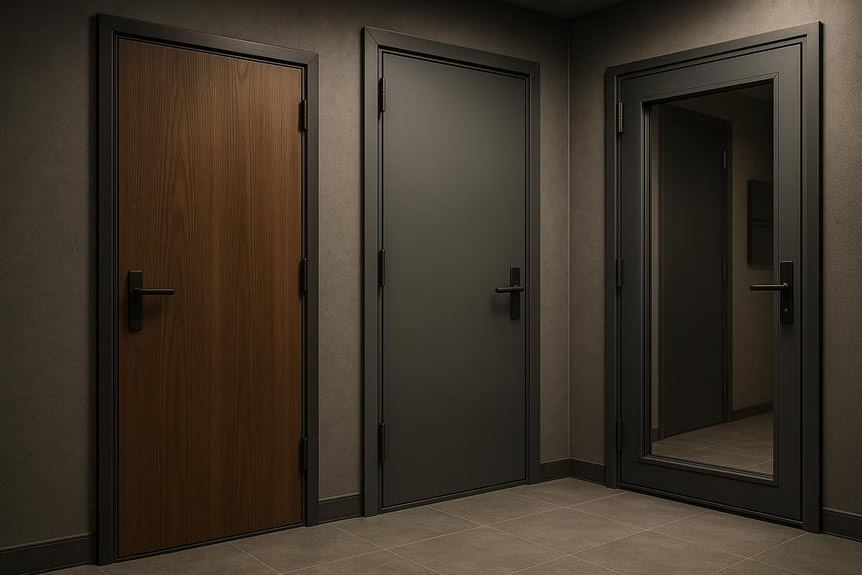
If you want a door that truly helps block noise, a solid-core door is the better choice over a hollow-core slab. The added mass typically improves sound reduction, often in the STC 27–30 range compared with about STC 20–25 for hollow-core doors. For meaningful performance, though, the door slab is only part of the solution. Tight weatherstripping, sealed jamb gaps, and a sweep or automatic door bottom are what help prevent sound from leaking around the perimeter. Glass inserts generally reduce acoustic privacy, especially as they get larger. At Total Home Interiors, we help homeowners and businesses in West Orange, Hoboken, Jersey City, and across the Tri-State area choose complete soundproofing solutions that perform better than basic door swaps alone.
Key Takeaways
- Solid-core doors generally block more noise than hollow-core doors because the added mass does a better job resisting airborne sound transmission. For homeowners dealing with hallway, apartment, or room-to-room noise, this is often the better starting point for privacy.
- In most cases, solid-core interior doors fall around STC 27–30, while hollow-core doors are typically closer to STC 20–25. That difference can be noticeable when you’re trying to reduce speech, TV noise, or everyday household sound.
- If stronger speech privacy is the goal, look for door assemblies in the STC 36+ range, where normal conversation is reduced to a faint murmur. Reaching that level usually requires more than just swapping the door slab—it often involves a professionally designed assembly.
- Seals are just as important as the door itself. Even a high-quality solid-core door can underperform if there are gaps at the sides, top, or bottom, since those openings allow sound to leak through easily.
- If glass is required, acoustic laminated glass and smaller glazed openings typically perform better than large standard glass panels. In general, more glass means less sound isolation, so careful specification is important when balancing privacy, aesthetics, and performance.
What Type of Door Blocks Sound Best?
If you want the best door for blocking sound, a solid-core door is usually the right choice. Its added mass helps reduce airborne noise far better than a hollow-core slab, with many solid-core doors performing around STC 27–30 and some denser molded options reaching roughly STC 32.
In practical terms, heavier, denser doors generally do a better job containing conversation, TV sound, and hallway or street noise.
Heavier, denser doors help reduce conversation, TV, hallway, and street noise more effectively in everyday living spaces.
That said, door performance is never just about the slab itself. At Total Home Interiors, we look at the full assembly—because even a premium solid-core door can underperform if sound is leaking around the frame, through the undercut, or at the latch side.
Small gaps make a big difference, which is why professional sealing, fit, and hardware adjustment matter just as much as door weight.
Adding dense neoprene seals, weatherstripping, and an automatic door bottom creates an airtight seal that helps block noise leakage around the perimeter.
It’s also important to separate real soundproofing from common DIY misconceptions. Basic foam weatherstripping applied without addressing door fit, perimeter leakage, and bottom seals rarely delivers meaningful noise control on its own.
Material density, tight closure, and proper installation are what make the difference.
For homeowners and apartments dealing with street noise, neighbor noise, or poor privacy, a solid-core door can be a strong upgrade—but only when it’s part of a professionally planned soundproofing approach.
Total Home Interiors helps clients across West Orange, Hoboken, Jersey City, NYC, and the Tri-State area identify where sound is getting through and recommend solutions that actually work.
Hollow Core or Solid Core Doors?
When comparing hollow core vs. solid core doors for noise control, solid core doors perform better in most homes. If voices, TV sound, or music are coming through interior rooms, a solid core door is usually the stronger option.
Typical hollow core doors are often around STC 20–25, while many solid core doors fall closer to STC 27–30, with some higher-performing assemblies reaching STC 32–37.
The difference comes down largely to mass. A hollow core slab may weigh roughly 25 pounds, while a solid core door often weighs 60–80 pounds or more.
That added density helps reduce sound transfer, but the door alone isn’t the whole solution. Even a heavier slab can underperform if there are air gaps around the frame, poor hinge alignment, or an unsealed undercut. Adding acoustic sealant around trim gaps and frame penetrations can further reduce sound leakage.
At Total Home Interiors, we help homeowners in West Orange, Hoboken, Jersey City, and across the Tri-State area look beyond the slab itself.
For clients dealing with bedroom privacy issues, home office distractions, or noise between living spaces, we evaluate the full door assembly, including perimeter sealing and fit, to improve real-world performance.
Hollow core doors may be acceptable for basic privacy, but for meaningful noise reduction, solid core is the more effective and professional-grade choice.
Why Do Solid-Core Doors Block More Noise?
Solid-core doors block more noise because their dense engineered-wood or composite core adds the mass needed to resist airborne sound far better than a lightweight hollow-core door. In real homes and apartments, that means voices, TV audio, and hallway noise have a harder time passing through the door slab.
Solid-core doors reduce everyday noise by adding dense mass that blocks voices, TV sound, and hallway disruptions more effectively.
- More mass helps reduce sound transfer, especially compared with hollow-core construction.
- Door thickness can help, but density and overall build quality matter more.
- A solid-core slab is typically less prone to vibration, which helps limit sound retransmission.
- Sealing is critical, because gaps at the perimeter or under the door can let noise leak through.
Using soundproof seals around the frame can significantly reduce noise leakage and help a solid-core door perform closer to its full potential.
In practice, solid-core interior doors usually provide a noticeable upgrade in privacy and everyday comfort. But the door itself is only part of the solution.
For homeowners in West Orange, Hoboken, Jersey City, and across the NYC metro area dealing with persistent noise issues, professional soundproofing delivers better results when door upgrades are paired with proper seals and a broader acoustic strategy.
That’s where Total Home Interiors helps, with expertly designed soundproofing solutions that go beyond DIY fixes.
What STC Rating Do You Need?
How much STC do you actually need for a door?
As a baseline, STC 25 offers only minimal privacy on an interior door. At that level, normal speech is still easy to understand through a closed door, so it’s not enough for homeowners dealing with shared walls, work-from-home calls, or family noise.
For better everyday privacy, it makes sense to look above STC 25. If your goal is a quieter bedroom, home office, nursery, or media room, STC 36 or higher is a much stronger target. Around that range, speech is often reduced to a faint murmur rather than clearly heard conversation, which creates a much more comfortable and private interior environment.
When comparing STC vs NRC, STC is the number that matters for doors because it measures how well a door assembly blocks sound transfer from one room to another. That’s why material and construction matter so much. Hollow-core doors often fall around STC 20 to 25, while solid-core doors typically perform closer to STC 27 to 30.
If you need more than that, true improvement usually comes from a complete soundproofing approach that includes door seals, perimeter gasketing, thresholds, and surrounding wall construction—not just the door slab itself. In higher-performance rooms, targeting an STC range closer to 55–60 is often associated with more effective sound isolation across the full assembly.
For most residential privacy applications, STC 36 is a practical benchmark. Beyond that, gains can become more dependent on the full assembly and professional installation quality.
For homeowners in West Orange, Hoboken, Jersey City, and across the NYC area, choosing the right door rating is often just one part of creating a quieter, more private space.
Do Glass Doors Block Less Sound?
Yes—glass doors typically block less sound than solid-core doors. In most cases, sound passes more easily through glazed openings because glass sections usually provide less overall mass and acoustic isolation than a full solid-core slab.
Even when a door includes premium glass, the glazing area often lowers the total sound-blocking performance compared with a similar solid door.
For homeowners and businesses in West Orange, Hoboken, Jersey City, and NYC dealing with privacy concerns, hallway noise, street noise, or room-to-room sound transfer, this matters when selecting doors for bedrooms, home offices, conference rooms, and media spaces.
- Choose acoustic laminated glass if visibility is important but you still want better noise control.
- Use smaller glass lites or limited glazing where possible, since more glass usually means more sound transmission.
- Expect solid-core doors to outperform hollow-core doors and most partially glazed options in acoustic separation.
- Pay close attention to seals, frames, and installation quality, since gaps around the door can significantly reduce sound isolation.
Using airtight seals around the door and nearby openings can further reduce sound leakage and improve overall acoustic performance.
As a general rule, if your goal is maximum privacy and noise reduction, less glass is usually the better choice.
For projects where both aesthetics and acoustic performance matter, Total Home Interiors can recommend professionally integrated soundproofing and acoustic solutions that balance design, function, and privacy.
Which Door Gaps Let Noise Leak In?
Even a solid, well-built door won’t do much for soundproofing if air is leaking around the edges. In most homes and apartments, the biggest problem areas are the perimeter gaps along the door jamb and top edge, where even small openings allow voices, hallway noise, and TV sound to pass through easily.
If the door or frame is out of alignment, the clearance becomes uneven, and the latch side or hinge side can become a direct path for noise transfer.
The bottom of the door is another common weak point. If the undercut is too large or the threshold isn’t sealed properly, that opening can compromise the entire assembly.
Worn or poorly fitted weatherstripping around the perimeter also reduces performance, because sound follows the same path as moving air. Applying weather-stripping foam tape and installing a door sweep can significantly reduce leakage at these weak points.
In some cases, noise isn’t only leaking around the door itself, but through the frame-to-wall joint, which should be professionally sealed as part of a complete soundproofing approach.
A simple first check is to look for visible light around the edges of the closed door. If light is coming through, sound is too.
Temporary blockers can help identify where the leakage is happening, but lasting improvement usually requires proper adjustment, sealing, and, in many cases, a more comprehensive acoustic solution.
For homeowners in West Orange, Jersey City, Hoboken, and across the Tri-State area, Total Home Interiors helps diagnose these weak points and recommend soundproofing strategies that deliver real, long-term noise control.
What Are the Best Seals for a Soundproof Door?
For a soundproof door, the best seals create continuous contact along the top and sides and a tight seal at the bottom, because sound travels through the same air gaps that allow light and drafts to pass. High-quality acoustic weatherstripping should compress firmly when the door closes, while the bottom of the door should use a proper sweep or, ideally, an automatic door bottom for a more dependable seal. Because acoustic sealant helps stop noise from spreading around perimeters, it can also be important to evaluate nearby joints and transitions as part of the overall door assembly.
- Install sound-rated weatherstripping on the jambs and header.
- Use an automatic door bottom for better performance than a basic sweep.
- Choose automatic seals on tile, hardwood, or uneven floors where consistent contact is harder to maintain.
- Check for adjacent flanking paths before upgrading the door seals alone.
The key principle is simple: if air leaks, sound leaks. A poorly fitted sweep or worn seal will limit performance, which is why professionally selected and installed door seals are often the difference between minor improvement and meaningful noise reduction.
For homeowners in West Orange, Hoboken, Jersey City, and NYC dealing with hallway noise, street noise, or privacy concerns, Total Home Interiors designs complete soundproofing solutions that go beyond DIY fixes to address the full noise path.
Should You Retrofit or Replace Your Door?
Before you replace the door, make sure the door slab is actually the weak point. A quick professional-style check is to temporarily seal the frame with towels or blankets, then listen for changes in noise levels. This helps diagnose flanking paths and reveals whether sound is leaking more through perimeter gaps, adjacent walls, ceilings, floors, or ventilation openings.
If that temporary sealing makes a noticeable difference, a retrofit is often the smarter first step—using quality weatherstripping, acoustic sealant, and a properly fitted door sweep or automatic drop seal. In multi-unit buildings, combining door upgrades with nearby wall improvements such as Mass Loaded Vinyl can further reduce airborne noise entering shared spaces.
Replacement makes more sense when you need meaningful STC improvement, especially in apartments, condos, and other urban spaces where privacy and quiet matter. Hollow-core doors typically perform around STC 20 to 25, while solid-core doors often reach STC 27 to 30.
However, premium materials alone won’t overcome poor installation. Door fit, frame squareness, latch pressure, and bottom-seal contact all need to be correct, or sound leakage will compromise performance.
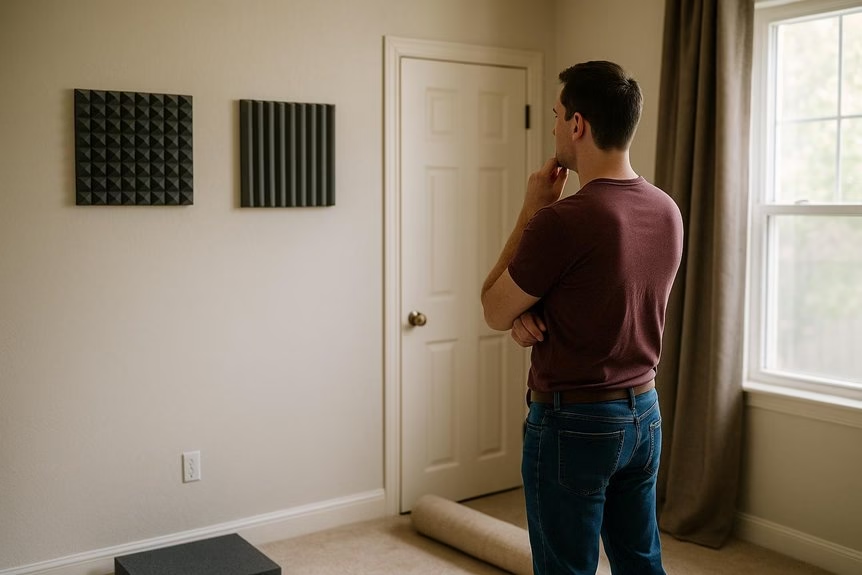
Thin foam stick-on panels rarely deliver worthwhile results.
For homeowners in West Orange, Hoboken, Jersey City, and across the Tri-State area, professional evaluation is the best way to determine whether retrofitting or replacing the door will produce the most effective noise-control outcome.
Which Soundproof Door Works Best by Room?
Which soundproof door works best depends on the room, the level of privacy you need, and how well the entire opening is sealed. At Total Home Interiors, we recommend focusing on door mass, proper fit, and professional perimeter sealing rather than assuming any door alone will solve noise problems.
The best soundproof door depends on room use, privacy needs, and how completely the entire opening is sealed.
For bedrooms and home offices, a solid-core door with high-quality full-perimeter seals and an automatic door bottom is typically the best choice for reducing household noise and improving sleep or focus.
In bathrooms, moisture-resistant solid-core doors help improve speech privacy when paired with tight weatherstripping and a reliable bottom seal.
For hallways or low-priority spaces, hollow-core doors may provide only basic separation, but they do very little to stop meaningful sound transfer.
For home theaters, the best results come from a heavy solid-core door, no glass whenever possible, and precise acoustic sealing at every edge.
- Bedrooms and home offices: solid-core door, typically STC 27–30 or higher
- Bathrooms: moisture-resistant solid-core construction with tight perimeter sealing
- Hallways: hollow-core only for minimal privacy, not true soundproofing
- Home theaters: maximum mass, no glass, and professional acoustic sealing
If the frame is out of square or you can see light around the edges, sound will still leak through.
That’s why professional installation and complete entryway sealing matter just as much as the door itself.
Professional installation also helps preserve long-term performance by ensuring precise sealing that minimizes leakage and reduces the risk of costly DIY mistakes.
How Do You Keep a Soundproof Door Working?
A soundproof door only works when the entire assembly is sealed correctly. Even a high-quality door will underperform if sound leaks around the perimeter, so the slab, frame, and rough opening all need to fit precisely. Continuous sealing at the head and jambs is essential—if air passes through, noise will too.
For better speech and household noise control, a solid-core door is typically far more effective than a hollow-core slab.
The threshold matters just as much. A properly fitted door sweep or automatic door bottom should make firm, consistent contact with the floor, especially where surfaces are uneven.
To keep performance from slipping over time, inspect gaskets, sweeps, and perimeter seals regularly for compression loss, gaps, or visible light at the edges.
Replacing worn components early helps preserve acoustic performance. Acoustic caulk at the frame and rough opening helps maintain airtightness, which is essential for preventing sound leakage.
For homeowners and commercial clients in West Orange, Hoboken, Jersey City, and NYC, professional installation is what makes the difference. A square frame, tight tolerances, and the right sealing details are critical to maintaining real sound control—not just the appearance of it.
Frequently Asked Questions
Can a Soundproof Door Improve Privacy Without Making the Room Feel Airtight?
Yes— a professionally specified soundproof door can improve privacy without making the room feel sealed off or uncomfortable.
The goal is to reduce speech transfer and outside noise by addressing the biggest sound leaks with solid-core doors, acoustic glass where needed, and high-quality perimeter seals.
In most cases, the room doesn’t need to be completely airtight; it needs proper acoustic detailing.
For the best result, Total Home Interiors pairs sound isolation with controlled ventilation solutions so the space stays quiet, private, and comfortable.
Do Soundproof Doors Affect Ventilation or Indoor Air Quality?
Yes—soundproof doors can affect ventilation and indoor air quality if they’re installed without a complete acoustic plan.
High-performance door seals and tighter assemblies help block noise, but they can also reduce natural airflow between rooms.
That’s why Total Home Interiors evaluates ventilation impact alongside sound control, helping homeowners improve privacy and quiet without creating stale or uncomfortable indoor conditions.
We recommend reviewing door seal performance, overall sound ratings, and post-installation airflow testing to ensure the space stays both peaceful and properly balanced.
Are Soundproof Doors Harder to Open or Close Daily?
No—when properly specified and professionally installed, soundproof doors shouldn’t feel difficult to open or close every day. At Total Home Interiors, we help homeowners throughout West Orange, NJ, Hoboken, Jersey City, and the greater NYC area choose acoustic door solutions that deliver noise control without sacrificing daily comfort.
While soundproof doors are often heavier than standard interior doors, premium hinges, seals, and hardware are designed to keep operation smooth and dependable. In most cases, the bigger issue isn’t the door itself, but poor installation, improper sizing, or low-quality components that can lead to dragging, resistance, or unreliable latching over time.
Can Renters Soundproof a Door Without Permanent Modifications?
Renters can improve a door’s sound performance with non-permanent measures like removable seals, draft blockers, and acoustic curtains, but these options only reduce minor sound leakage—they don’t truly soundproof a door.
If noise from hallways, neighbors, or shared building spaces is a constant issue, the most effective results typically come from professionally designed soundproofing strategies that address the full assembly, not just the door itself.
Total Home Interiors helps clients across West Orange, NJ and the Tri-State area evaluate practical noise-control solutions that protect comfort, privacy, and long-term property value.
Do Soundproof Doors Also Help With Heat Loss and Drafts?
Yes—soundproof doors can also help reduce heat loss and drafts.
Many premium soundproof door systems use dense cores, perimeter seals, door sweeps, and well-fitted frames that limit air movement as well as noise transfer.
When a door closes tightly, it can improve comfort, support better energy efficiency, and reduce the cold spots caused by air leaks around the edges.
The biggest benefit comes from proper sealing at the threshold, jamb, and sweep—areas where both sound and drafts commonly enter.
For homeowners dealing with noise and comfort issues, professional door sealing and soundproofing solutions can address both at once.
Conclusion
If you want a door that truly reduces noise, a solid-core door with professional perimeter seals and an automatic door bottom will usually perform far better than a hollow interior door. In many homes and apartments across West Orange, Hoboken, Jersey City, and NYC, a full replacement is not always the first step—upgrading the seals around an existing door can deliver a meaningful improvement when gaps are the main problem. The key is evaluating door mass, air leakage, and how the room is used so you invest in a soundproofing solution that actually works. For the best results, Total Home Interiors designs integrated acoustic solutions tailored to the space, rather than relying on one-size-fits-all DIY fixes.