Noise Reduction Coefficient, or NRC, measures how much sound a material absorbs within a room, not how well it stops noise from entering through walls, ceilings, floors, or windows. In homes, apartments, offices, restaurants, and other shared spaces across West Orange, NJ and the Tri-State area, a higher NRC can mean less echo, fewer hard reflections, and clearer conversation—especially in the speech frequencies that affect comfort, focus, and day-to-day usability. Because NRC does not measure soundproofing performance, bass control, or full-spectrum acoustic behavior, it should be used as one part of a professional acoustic plan rather than the only number guiding your decision.
Key Takeaways
- NRC, or Noise Reduction Coefficient, tells you how much sound a material absorbs inside a room. It’s useful for reducing echo, softening harsh reflections, and improving speech comfort in spaces like home offices, media rooms, restaurants, and conference areas.
- NRC is not a soundproofing rating. It does not tell you how well a wall, ceiling, floor, or window blocks noise from neighbors, traffic, or adjacent rooms, and it does not fully reflect low-frequency issues like bass, street rumble, or HVAC vibration.
- The rating is calculated by averaging sound absorption at 250, 500, 1,000, and 2,000 Hz, then rounding to the nearest 0.05. This makes NRC a helpful general benchmark for mid-frequency acoustic performance.
- NRC performance depends on the material itself, as well as thickness, density, and installation method. In many professional acoustic treatments, even an air gap behind a panel can significantly improve absorption.
- As a general guide, NRC 0.70 to 1.00 indicates high absorption, 0.50 to 0.70 offers moderate acoustic improvement, and below 0.30 usually delivers limited impact on room echo.
- For homeowners and businesses in West Orange, NJ and the Tri-State area, understanding NRC helps clarify whether you need acoustic treatment to improve sound quality within a space, or true soundproofing construction to reduce noise transfer between spaces.
What Does an NRC Rating Measure?
An NRC rating measures how much sound a material absorbs—not how much sound it blocks. For homeowners and businesses dealing with echo, harsh reflections, or poor speech clarity, this number helps explain how a surface improves the acoustic feel of a room. In professional reverberation chamber testing, products are measured consistently so acoustic materials can be compared more accurately.
NRC is shown on a scale from 0.0 to 1.0. Higher numbers mean the material absorbs more reflected sound and reduces reverberation within the space. For example, an NRC of 0.80 means the product absorbs about 80% of incident mid-frequency sound energy under the test standard. For strong echo control, many acoustic panels are selected with high NRC ratings in the 0.7 to 1.0 range.
Because NRC is based on an average of specific mid-range frequencies, it’s most useful for evaluating echo control and speech comfort—not for judging low-frequency bass control or true soundproofing between rooms.
At Total Home Interiors, we help clients throughout West Orange, Hoboken, Jersey City, NYC, and the surrounding Tri-State area understand the difference between acoustic treatment and soundproofing, so the right solution is specified for the problem.
If your goal is a quieter, more comfortable home, office, restaurant, or media space, NRC is one important part of choosing the right acoustic materials.
How Is NRC Calculated?
Most NRC ratings are determined through controlled reverberation-room testing, where a material’s sound absorption is measured at 250, 500, 1,000, and 2,000 Hz under ASTM C423 or a similar standard.
In this process, each frequency receives an absorption coefficient, and those four numbers are averaged to produce a single raw NRC value.
Each tested frequency is assigned an absorption coefficient, and those values are averaged into one raw NRC figure.
- Test the material sample in a reverberation room.
- Measure absorption at four standard frequencies.
- Average the four coefficients arithmetically.
- Round the result to the nearest 0.05.
That rounded number becomes the published NRC, typically shown on a scale from 0.0 to 1.0.
However, NRC should always be interpreted in context.
Because NRC mainly reflects absorption in speech-range and upper frequencies, bass traps are still needed to manage low-frequency buildup that standard panels do not fully address.
Mounting conditions and installation methods can change the result, which means the same acoustic panel or ceiling product may perform differently depending on how and where it’s installed.
For homeowners and commercial clients in West Orange, Hoboken, Jersey City, and the greater NYC area, this is an important distinction.
A product’s lab rating is useful, but real-world acoustic performance depends on proper specification and professional installation.
At Total Home Interiors, we help clients look beyond the number alone to choose acoustic treatments that match the actual space, noise issues, and design goals.
What Frequencies Does NRC Miss?
NRC can miss critical parts of the sound spectrum because it averages absorption only at 250, 500, 1,000, and 2,000 Hz. For homeowners and businesses dealing with real-world noise problems, that creates frequency gaps that can lead to the wrong expectations about how a product will actually perform.
Below roughly 200 Hz, NRC may not fully reflect low-frequency issues like traffic rumble, HVAC vibration, mechanical noise, or bass buildup traveling through walls and ceilings. Bass traps placed in corners can help address these issues by targeting low-frequency buildup that NRC does not capture well. Above about 2,500 Hz, it can also overlook sharper sounds such as hiss, sibilance, and certain high-frequency echoes.
As a result, two acoustic products may carry the same NRC rating while performing very differently in your space.
That matters in apartments, condos, offices, restaurants, and media rooms throughout New Jersey and NYC, where noise problems rarely stay confined to just midrange frequencies.
If your goal is better speech clarity, improved privacy, or relief from neighbor and street noise, frequency-specific acoustic data is far more useful than relying on NRC alone. At Total Home Interiors, we look beyond a single rating to recommend acoustic and sound control solutions that match how your room is actually used.
How Do Material and Thickness Affect NRC?
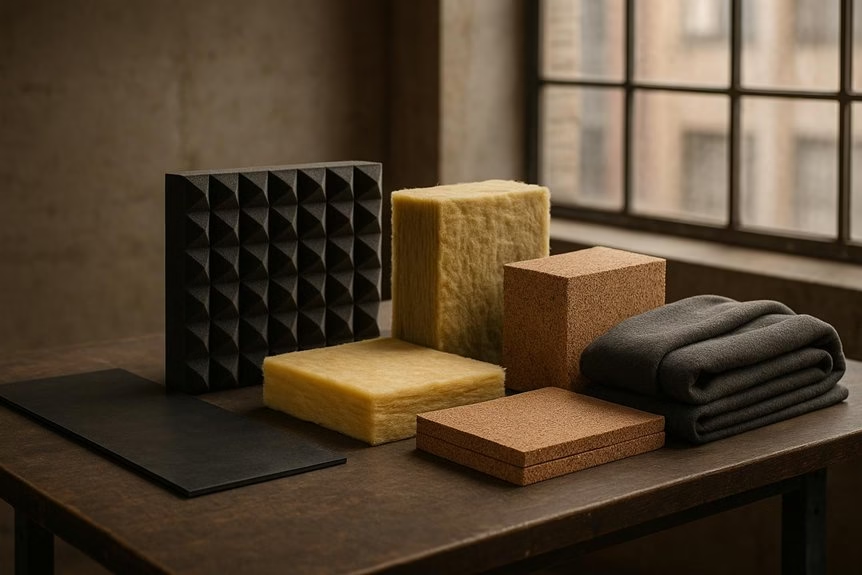
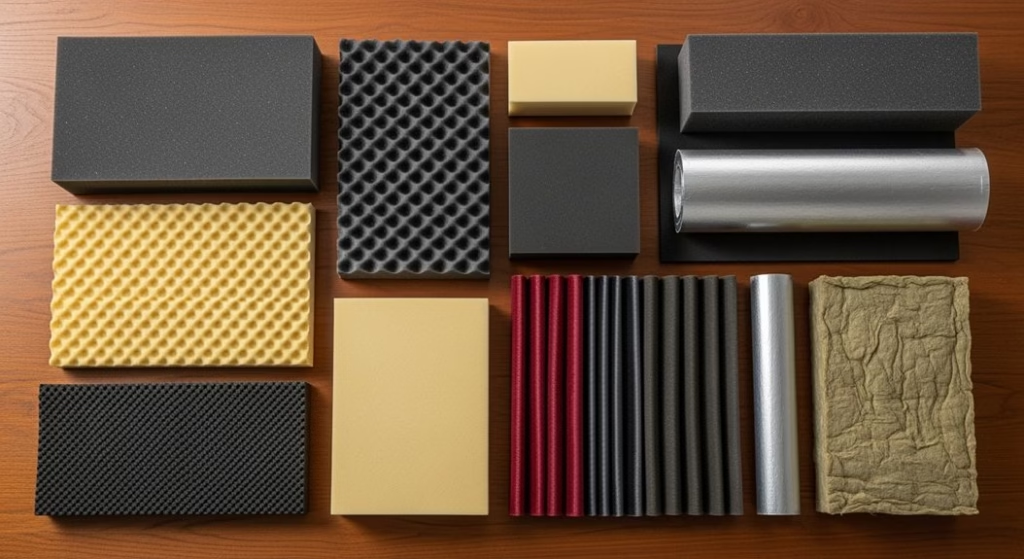
Because NRC measures how much sound a surface absorbs across important midrange frequencies, the material and its thickness have a direct impact on the rating. In most acoustic treatments, porous, fibrous materials outperform hard, sealed surfaces because they allow sound to enter the panel and lose energy within it.
Porous, fibrous acoustic materials usually achieve higher NRC because they absorb midrange sound more effectively than hard, sealed surfaces.
- Porous materials help trap and dissipate sound energy.
- Greater thickness gives sound waves more room to be absorbed.
- Proper thickness can improve performance within key NRC test bands.
- Density matters most when paired with the right airflow resistance.
Heavier doesn’t automatically mean better. NRC improves when material composition, density, and thickness work together to create effective sound absorption.
Since NRC is based on performance at 250, 500, 1000, and 2000 Hz, any change that improves absorption across those frequencies can raise the final rating.
Thicker, denser panels can also improve absorption over a wider range, especially when used in primary reflection points to reduce echoes and improve clarity.
For homeowners and businesses dealing with echo, harsh reflections, or poor speech clarity, this is why professionally selected acoustic panels often perform better than generic products. At Total Home Interiors, we help clients in West Orange, Hoboken, Jersey City, and throughout the Tri-State area choose acoustic solutions that match the space, the noise issue, and the design goals.
How Does Mounting Affect NRC?
In acoustic testing and real-world installations, mounting can affect NRC almost as much as the acoustic panel itself because it changes how sound reaches and moves through the material. A panel mounted directly to a rigid wall will often perform differently than the same panel installed with an air gap behind it.
These cavity effects can change the absorption coefficients measured at 250, 500, 1,000, and 2,000 Hz, which are the frequencies used to calculate NRC.
In many cases, leaving a 20–50 mm air space can improve NRC by roughly 10–20%, particularly by increasing absorption in the mid and lower frequencies.
Mounting method, surface finish, and laboratory test conditions such as Type A or Type E can also affect the final rounded NRC value.
For homeowners and commercial clients dealing with echo, noise, or speech clarity issues, this is why professional acoustic design matters. The same product can deliver very different results depending on how it’s installed.
In some rooms, combining proper panel mounting with acoustic treatments can further reduce reverberation and improve speech clarity without compromising design.
At Total Home Interiors, we account for mounting conditions as part of a complete acoustic solution, helping clients across West Orange, NJ, Jersey City, Hoboken, and the NYC area achieve more predictable, effective sound control.
What Is a Good NRC Rating?
For many homes, offices, conference rooms, restaurants, and media spaces, that range is a solid benchmark when speech clarity and comfort matter.
- 0.70–1.00: high sound absorption for offices, classrooms, conference rooms, studios, theaters, and open-plan interiors
- 0.50–0.70: a practical improvement range for many everyday interiors, including typical office environments
- Below 0.30–0.40: limited impact on its own, though wider coverage can still provide noticeable benefit
- NRC is based on 250, 500, 1,000, and 2,000 Hz: then rounded to the nearest 0.05
The key is that “good” is always context-driven.
NRC measures mid-frequency absorption, so it’s most useful for evaluating echo control and speech comfort—not low-frequency rumble or highly specific soundproofing concerns.
Because NRC does not reflect low-frequency control, bass issues often require dedicated bass traps or deeper treatment strategies beyond standard panels.
If you’re dealing with noisy neighbors, street noise, or privacy issues between rooms, NRC is only one part of the bigger acoustic picture.
At Total Home Interiors, we help homeowners and businesses across West Orange, NJ, Jersey City, Hoboken, and NYC choose the right acoustic treatments for both performance and aesthetics—especially in spaces where comfort, privacy, and professional results matter.
Is a Higher NRC Rating Always Better?
A higher NRC rating generally means a material absorbs more reflected mid-frequency sound, but that doesn’t automatically make it the best choice for every room.
In residential and commercial acoustic design, the goal isn’t to remove as much sound as possible—it is to create the right balance for how the space should feel and function.
If too many surfaces are covered with high-NRC materials without a professional plan, a room can become over-damped, making it feel unnaturally flat and less comfortable for conversation.
It is also important to understand that NRC is only an average of absorption performance across select mid frequencies, not a complete picture of how a product performs across the full sound spectrum.
Two materials with the same NRC can behave very differently at low, mid, and high frequencies.
That’s why one rating alone should never drive an acoustic treatment decision.
At Total Home Interiors, we design acoustic solutions around the specific needs of the space—whether that means improving speech clarity in an office, reducing echo in a restaurant, or creating a more comfortable, controlled sound environment in a home.
In many homes and offices, materials in the 0.5 to 0.7 range can provide an excellent balance of speech comfort and liveliness, while restaurants, conference rooms, and other speech-focused environments often benefit from 0.7 to 0.9 or higher when applied strategically.
Effective acoustic design also depends on first reflection points, room dimensions, and balancing absorption with diffusion so the space stays clear without sounding unnaturally dull.
NRC vs SAA: What’s the Difference?
- NRC (Noise Reduction Coefficient) averages sound absorption at 250, 500, 1,000, and 2,000 Hz.
- It’s rounded to the nearest 0.05, so it offers a simplified snapshot focused largely on the speech range.
- SAA (Sound Absorption Average) uses 12 frequency bands from 200 to 2,500 Hz, which provides a broader and more accurate view of performance.
Because SAA covers more frequencies, two products can share the same NRC rating while performing differently in the real world. In hospitality settings, maintaining speech clarity is especially important because excessive echo and reverberation can directly affect customer comfort and conversation.
Two acoustic products may share the same NRC, yet deliver noticeably different real-world sound absorption performance.
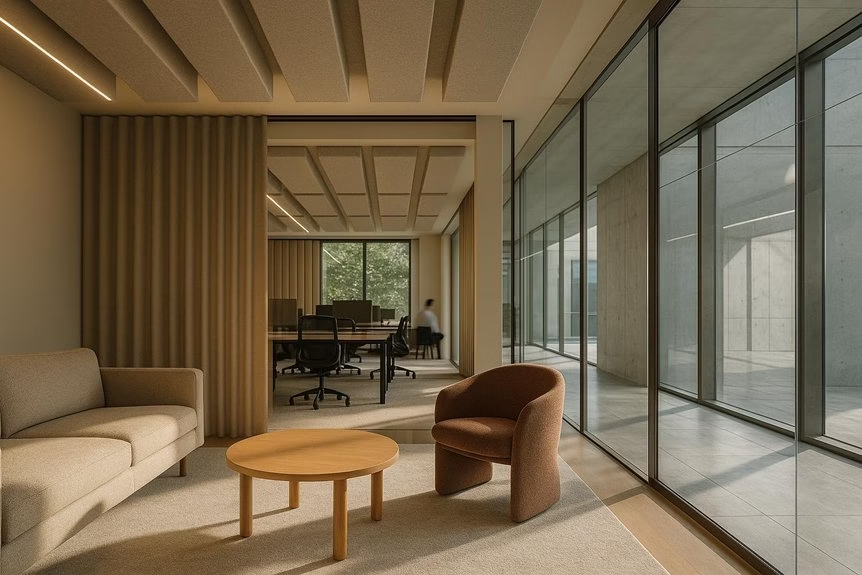
For speech-focused environments like conference rooms, restaurants, media spaces, and work-from-home offices, NRC can still be a useful quick reference.
But if you want a clearer understanding of how a product will manage echo, reverberation, and overall sound quality across a wider range, SAA is typically the better metric to review.
As NRC becomes less emphasized in current specifications, it’s smart to evaluate SAA alongside NRC when selecting acoustic treatments.
At Total Home Interiors, we help clients across West Orange, NJ, NYC, Hoboken, and Jersey City choose the right acoustic solutions based on real performance—not just a single number on a product sheet.
NRC vs STC: Absorption vs Blocking
While NRC and STC often appear together on product specifications, they describe two very different aspects of sound control. NRC measures how much sound a material absorbs within a room, which helps reduce echo, ringing, and excessive reverberation. It’s based on an average of absorption performance at 250, 500, 1,000, and 2,000 Hz, rounded to the nearest 0.05.
STC, by contrast, measures how well a wall, ceiling, door, or partition reduces airborne sound transfer between spaces. If your goal is better speech clarity, less harshness, or a more comfortable-sounding room, NRC is the metric that matters during acoustics planning. If the problem is conversation, TV noise, or street sound coming from outside the space, STC is the more relevant standard.
This distinction is important for homeowners and businesses dealing with noise frustrations in places like Jersey City, Hoboken, NYC, and across Northern New Jersey. High-NRC acoustic panels can make a room sound calmer and more controlled, but they don’t stop sound from passing through walls.
True soundproofing depends on construction methods such as added mass, decoupling, insulation, and proper sealing. Techniques like resilient channels can further improve sound isolation by reducing airborne and impact noise in walls and ceilings. NRC performance, on the other hand, depends on the material itself, along with its thickness, density, and mounting method.
At Total Home Interiors, we help clients choose the right solution for the actual problem—whether that means improving room acoustics with custom acoustic treatments or reducing noise transfer with professionally designed soundproofing systems.
How to Choose the Right NRC Rating
Choosing the right NRC rating starts with the specific acoustic issue in your space, not simply the highest number available. At Total Home Interiors, we recommend setting your acoustic goals first, because NRC measures sound absorption primarily at 250, 500, 1,000, and 2,000 Hz—making it especially useful for improving speech clarity and reducing echo in homes, offices, restaurants, and meeting spaces.
Choose NRC based on your room’s acoustic goals, not just the highest rating available.
Use the room type and how the space is used to guide the right target range:
- 0.5–0.7 NRC works well for many residential spaces, home offices, and general-use offices.
- 0.7–0.9 NRC is often a better fit for restaurants, conference rooms, and other conversation-heavy environments.
- 0.9+ NRC is best where sound clarity is especially important, such as studios, theaters, and dedicated media rooms.
It’s also important to review certified lab data and make sure the panel’s mounting method matches real-world installation conditions. Thickness, density, and any air gap behind the panel all affect performance; in many cases, a 20–50 mm air cavity** can improve effective absorption. Sustainable panel materials such as recycled polyester felt** can also support acoustic performance while offering eco-friendly design flexibility for homes and offices.
Most importantly, higher NRC isn’t always better. Over-absorbing a room can make it feel flat or unnaturally dead. The best results come from a professionally planned acoustic treatment strategy that balances comfort, clarity, and aesthetics for the way you actually live or work. If you’re dealing with echo, noise distractions, or poor speech intelligibility in New Jersey, NYC, Hoboken, or Jersey City, Total Home Interiors can help design the right solution.
Frequently Asked Questions
Can NRC Ratings Change as Acoustic Materials Age?
Yes, NRC ratings can change as acoustic materials age, especially when products are exposed to dust, moisture, impact, or long-term compression. In real spaces, sound absorption may decline as panel surfaces harden, internal fibers settle, or installation conditions shift over time.
That said, performance changes aren’t always obvious without a professional evaluation, since mounting methods, air gaps, backing materials, and room conditions all affect results.
For homeowners and businesses dealing with echo, noise distractions, or reduced speech clarity, regular inspection of acoustic treatments is important. At Total Home Interiors, we help clients across West Orange, NJ, Jersey City, Hoboken, and the greater NYC area assess whether existing acoustic panels and sound control materials are still performing as intended.
When needed, we recommend premium replacement or upgraded acoustic solutions designed for long-term results, cleaner aesthetics, and better overall sound quality.
Does Paint or Fabric Covering Affect a Panel’s NRC?
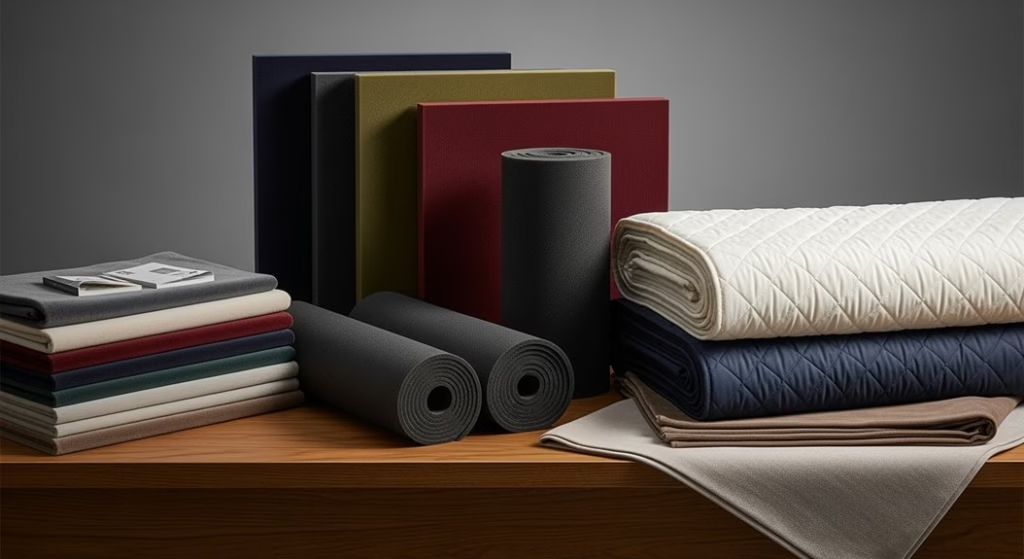
Yes—paint or fabric covering can affect a panel’s NRC. Heavy paint or glossy coatings can reduce sound absorption by sealing the panel’s porous surface, while acoustically transparent fabric typically helps preserve performance.
For the best results, coverings should be selected to match the panel’s acoustic design and application.
At Total Home Interiors, we recommend professionally specified acoustic panels and fabric-wrapped wall treatments that balance sound control, aesthetics, and long-term performance for homes and commercial spaces throughout West Orange, NJ, and the Tri-State area.
Are NRC Tests Performed Differently in Various Countries?
Yes, NRC tests can vary somewhat from country to country, even though the underlying goal is generally the same. Different regions may follow different laboratory standards, testing methods, or reporting practices, which can lead to small differences in published ratings for acoustic panels and other sound-absorbing materials.
That’s why it’s important to look at which standard was used before comparing products directly.
For homeowners and businesses in places like NYC, Hoboken, Jersey City, and West Orange, what matters most is working with an experienced acoustic professional who understands how lab ratings translate into real-world performance.
At Total Home Interiors, we help clients evaluate acoustic materials correctly so they support the right outcome—whether that means reducing echo in a restaurant, improving speech clarity in an office, or creating a quieter, more comfortable home environment.
Can Humidity or Temperature Influence Real-World NRC Performance?
Yes—humidity and temperature can influence real-world NRC performance.
Acoustic materials such as fiberglass, mineral wool, and fabric-wrapped panels may absorb sound slightly differently as moisture levels and air temperature change, which can affect reverberation in a space.
Changes in air density also play a role, particularly at higher frequencies.
While these shifts are usually modest, laboratory NRC ratings don’t fully reflect every real-world condition.
For homeowners and businesses in West Orange, NJ, Jersey City, Hoboken, and NYC, that’s why professional acoustic design and proper material selection matter when planning long-term sound control performance.
Do Acoustic Panels With the Same NRC Always Sound Identical?
No, acoustic panels with the same NRC won’t always sound identical in your space. NRC is only a single average rating, so two panels can perform very differently across speech frequencies, echo control, and overall room tone.
Mounting method, air gap, panel thickness, surface finish, and even surrounding wall construction all affect real-world results. That’s why at Total Home Interiors, we evaluate the full acoustic behavior of a room—not just the spec sheet—to recommend panel systems that deliver the right sound quality for your home, office, studio, or theater.
Conclusion
NRC tells you how much sound a material absorbs, but it does not tell you everything about how a room will feel, function, or sound. A higher NRC does not automatically mean better acoustics for your home, office, or media space. To make the right choice, you also need to consider which frequencies are being controlled, how the product is mounted, its thickness, and whether your goal is sound absorption or true soundproofing. At Total Home Interiors, we help homeowners and businesses across West Orange, Hoboken, Jersey City, and NYC look beyond the rating so they can select acoustic solutions that improve comfort, privacy, and performance.